
How to make a resume for your first job, step by step
To make a resume for your first job, put your contact details at the top, add a two-line summary, then your school. Fill the experience space with what you have done unpaid: babysitting, volunteering, clubs, sports, school projects. Add skills and the hours you can work, keep it to one page, and save it as a PDF.
Building, editing and downloading are free. Downloading the PDF needs a free account.
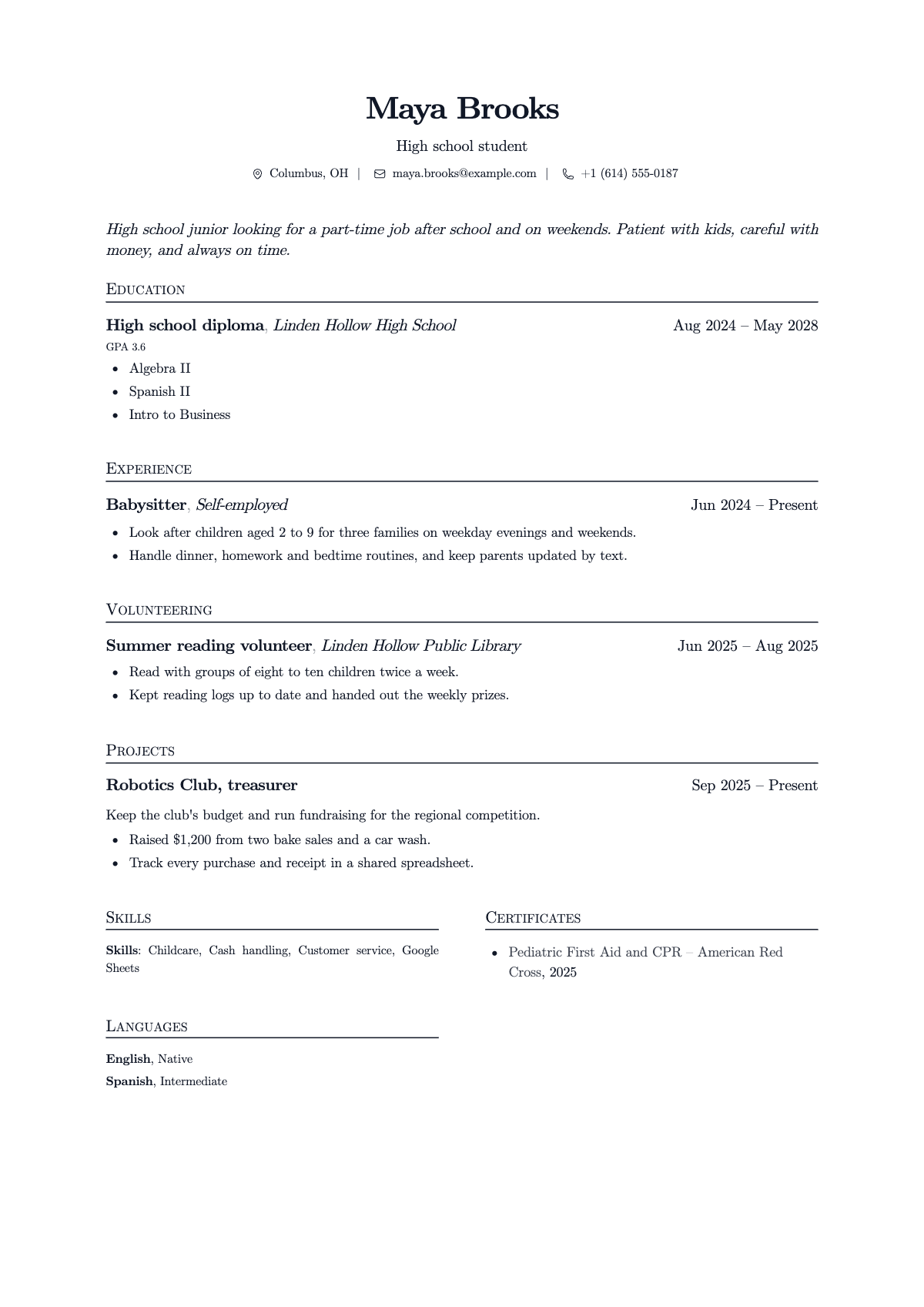
A first resume is short, and that is fine. Nobody expects a work history from someone applying for their first job. What the manager wants to see is that you turn up, can be trusted, and have done something on a regular basis. The seven steps below give you a page that shows that, in the order the sections print.
Step 1: Put your contact details at the top
Four lines are enough: your name, your city and state, your phone number and an email address you check.
Use an email made from your name. If yours is a nickname from middle school, make a new one for job applications. Leave off your full street address, your age, a photo and your social media.
Step 2: Write a two-line summary
The summary sits under your name and says what you want and why you would be good at it. Two sentences. Pick the one closest to you and change the details:
Skip the word "objective" and skip lines like "hard-working team player". Say something a manager can picture.
Step 3: Add your school
With no jobs yet, school is your strongest section, so it goes right after the summary.
Add your GPA if it helps you (usually 3.0 or higher). Name two or three classes that fit the job: a business class for retail, a cooking class for a restaurant. If you have already finished school, write "High school diploma, 2025". If you are not sure whether high school belongs on your resume at all, here is the answer for each case.
Step 4: Turn what you have done into experience
This is the step people get stuck on. You have more than you think. Anything you have done more than once, for someone else, counts. Give it a title, dates, and one or two lines about what you did.
| What you did | Title to write | A line to copy |
|---|---|---|
| Watched a neighbor's kids | Babysitter | Look after two children, ages 4 and 7, two evenings a week. |
| Walked or fed pets | Pet sitter | Walk and feed dogs for four families while they travel. |
| Cut grass or shoveled snow | Yard work, self-employed | Mow five lawns a week in summer and keep my own schedule. |
| Volunteered | Volunteer, [place] | Sort donations at the food pantry every other Saturday. |
| Played a sport | [Sport] team member | Practice five days a week and travel to weekend meets. |
| Helped run a club | Treasurer, [club] | Keep the club's budget and record every purchase. |
| Did a big school project | Team lead, [class] project | Planned a class fundraiser with four classmates that raised $400. |
| Cared for siblings | Family caregiver | Get two younger brothers to school and help with homework daily. |
Write each line the same way: a verb, what you did, and how often or how many. Use a number only when you know it. "Raised $400" is good if it is true; "increased sales by 50%" is not something a first resume needs.
Call this section "Experience" if you have a paid gig like babysitting, or "Activities and volunteering" if everything is unpaid. Both are normal.
Step 5: List skills you can back up
Pick four to six skills, and choose ones your experience above already shows.
- Customer service (from volunteering at the front desk)
- Cash handling (from a club fundraiser)
- Childcare (from babysitting)
- Google Docs and Sheets (from school)
- A second language, and how well you speak it
Leave out "hard worker", "team player" and "fast learner". Every applicant writes them, so they say nothing.
Step 6: Add the extras that count
These short sections fill a thin page with things a manager actually checks for:
- Certificates: first aid and CPR, a food handler card, a lifeguard certificate.
- Awards: honor roll, a sports award, perfect attendance.
- Availability: when you can work. For a first part-time job this line matters more than you would guess.
If you are 14 or 15, the hours you list need to fit the federal limits on teen work, and your state can be stricter. The resume for teenagers page has the rules for each age, and jobs for 15 year olds lists the jobs that hire at that age.
Step 7: Check it, keep it to one page, save it as a PDF
Before you send it:
- Your phone number and email are right. Call yourself and send yourself an email to check.
- Every entry has a month and year, like "June 2025 to present".
- Each line starts with a verb, and all of them use the same tense (present for things you still do).
- It fits on one page.
- Someone else has read it for typos.
- It is saved as a PDF named after you, like
Maya-Brooks-Resume.pdf, so it looks the same on the manager's screen as on yours.
If you would rather not format any of this yourself, the builder at the top of this page asks for each section one question at a time and lays it out for you.
Questions
Do I need a resume for my first job?
Not always. Many first jobs take an online application with no resume. Having one still helps: you can attach it, hand it in with a paper application, and copy from it when a form asks the same questions.
What do I put on a resume if I have never had a job?
Your school, then anything you have done regularly: babysitting, pet sitting, mowing lawns, volunteering, clubs, sports, school projects. Describe each one in a line that starts with a verb, the same way you would describe a job.
How long should a first resume be?
One page. A first resume is usually half a page to a page, and that is normal.
Should I put references on my first resume?
No. Leave them off and have two names ready (a teacher, a coach, a family you babysat for) in case the employer asks.
Can I make my first resume on my phone?
Yes. The builder on this page works in your phone's browser with nothing to install. Building it needs no account; downloading the PDF needs a free one, with no card.
Sources
- U.S. Department of Labor, YouthRules: 14 and 15 year olds, non-agricultural jobs, Read October 2, 2026
Start your resume
Building, editing and downloading are free. Downloading the PDF needs a free account.
Want a second opinion? Jobician, from the same team, scores your resume the way hiring software reads it. Check it on Jobician