
How to write a career change resume, with examples for each kind of switch
A career change resume opens with a summary that names the job you want and the skills that carry over. Put your strongest proof for the new field near the top: a certificate, a project or your skills. Then rewrite your old bullets in the new field's words. Change the emphasis, never the facts.
Building, editing and downloading are free. Downloading the PDF needs a free account.
Start with a summary that names the new job
The first thing a recruiter needs to know is that you are applying on purpose. Your summary says it in two or three sentences: what you have done, what carries over, and the job you want now. Use this shape:
Filled in for different switches:
Put the right section first
A normal resume starts with experience. On a career change, your most recent job may be the least relevant thing on the page, so move your best proof above it.
| Your situation | Section order |
|---|---|
| You earned a certificate or degree for the new field | Summary, Certificates or Education, Skills, Experience |
| You have a project or portfolio piece | Summary, Projects, Experience, Skills, Education |
| Same kind of work, new industry | Summary, Experience, Skills, Education |
| Little to show yet beyond your old job | Summary, Skills, Experience, Education |
Keep every job in date order, with its dates. A resume that hides the dates reads as hiding something.
Rewrite your bullets in the new field's words
Your old job did more of the new one than its title says. Find those parts, put them first, and describe them in the words the new field's job postings use. Keep the facts the same.
| Switch | Before | After |
|---|---|---|
| Teacher to instructional designer | Taught 7th grade science to five classes. | Designed a year-long science course with 20 hands-on labs, written backward from the state standards. |
| Store manager to HR | Managed a store of 25 employees. | Hired and onboarded about 15 seasonal staff each fall, and wrote the training checklist the district now uses. |
| Server to sales | Served tables and took orders. | Suggested wine and specials to about 100 guests a night; my average check was among the highest on staff. |
| Admin to project coordinator | Answered phones and kept the calendar. | Tracked filing deadlines for 60 open cases and sent reminders, so none were missed in two years. |
Two checks before you keep a bullet: could you explain it in an interview, and would your old manager agree with it? If not, cut it back until both are true.
Show proof from outside your job
If the new field wants something your job did not give you, add it as its own entry, written like a job:
- A course or certificate: the name, who issued it, and the month you finished.
- A project: a short description and one line on what came of it. Volunteer work for a local group counts.
- Freelance or part-time work in the new field, even a few small jobs.
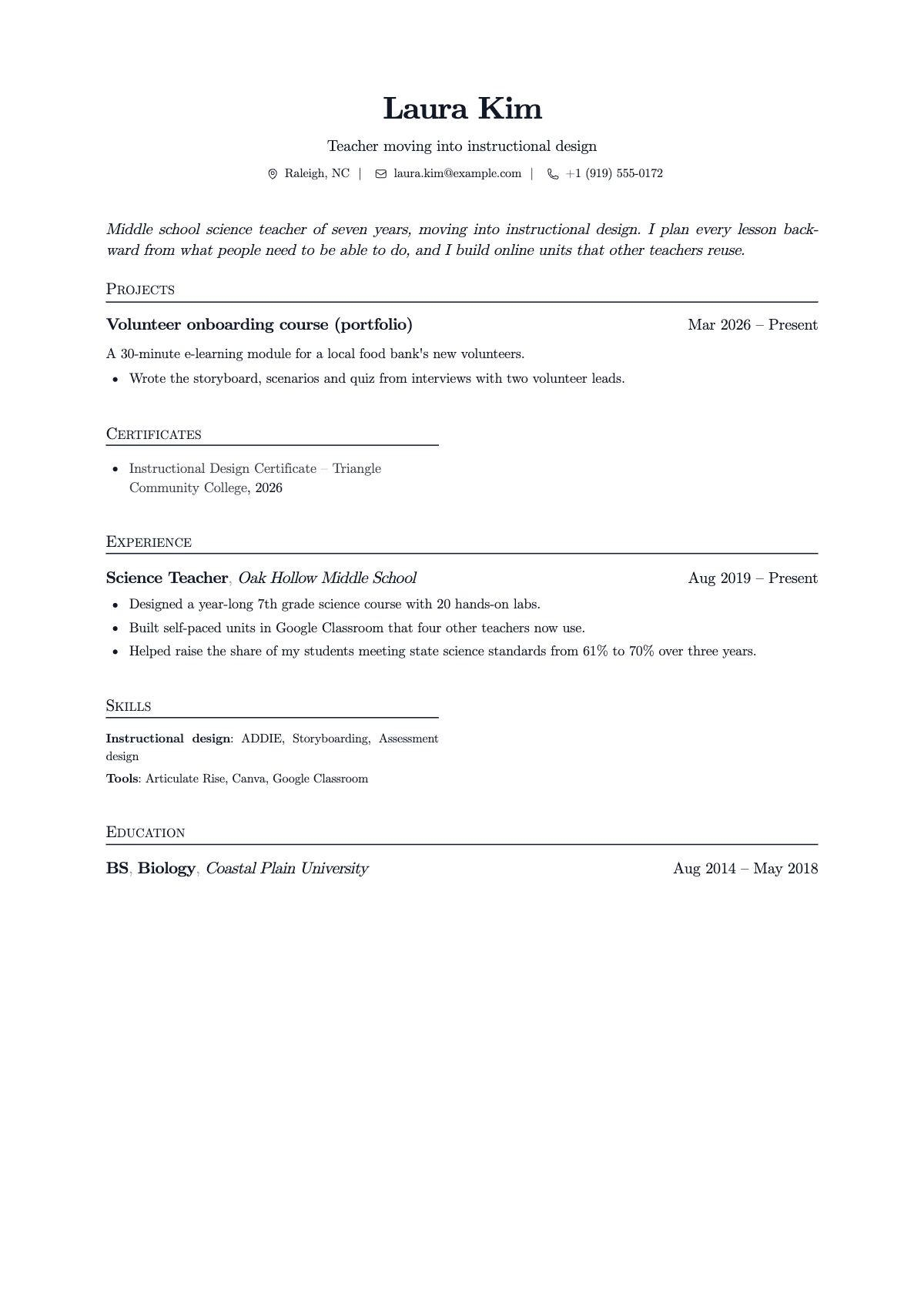
The example resume on this page does this with one portfolio project and a certificate, placed above the teaching job.
What to leave out
- Duties that only make sense in the old field, such as menu knowledge on a sales resume.
- Old-field jargon the new reader will not know. "IEP" means nothing to most hiring managers outside schools; "individual learning plans" does.
- An apology for the switch. Say what you want, not why you are leaving.
- Jobs from more than 15 years ago, unless they are in the new field.
Changing careers at 40 or 50
The same rules apply, and your years of work are an advantage when you frame them for the new job. Show the last 10 to 15 years in detail (more on how far back a resume should go). Fold older jobs into one line, or leave them off. Lead with the summary and the proof, and let your experience show in how specific your bullets are.
Before you send it
- Your summary names the job in the posting.
- The first third of the page is about the new field.
- Every bullet is true and you could talk about it for a minute.
- It fits on one page, two at most if you have more than ten years of relevant work (see how long a resume should be).
Questions
Should I use a functional resume for a career change?
Usually not. A resume with only skills and no dated jobs makes readers wonder what is missing. Keep your jobs in date order, and add a skills or projects section above them instead.
Objective or summary on a career change resume?
Write a summary with the objective built in: two or three sentences that say what you have done, what carries over, and the job you want. That one paragraph does both jobs.
How do I write a career change resume with no experience in the new field?
Use what you have: a course or certificate, a project you did on your own or as a volunteer, and the parts of your current job that already look like the new one. One real project beats a long list of skills.
Is 40 or 50 too late to change careers on a resume?
No. Show the last 10 to 15 years in detail, summarize anything older in a line or leave it off, and lead with what you can do in the new role.
Start your resume
Building, editing and downloading are free. Downloading the PDF needs a free account.
Applying to a specific job? Jobician, from the same team, tailors your resume to the posting and drafts the cover letter. See Jobician