
Medical assistant resume examples, front office and back
A medical assistant resume shows two things fast: your credential (CMA, RMA or another, plus BLS) and that you can do both halves of the job, clinical and front office. List each with real volumes, like patients roomed a day. New MAs lead with their program and externship, which count as experience.
Building, editing and downloading are free. Downloading the PDF needs a free account.
What an office manager looks for first
Medical assistants interview patients and record their history, take vital signs, help providers with exams, and schedule appointments. A clinic hiring one wants to know, in the first few seconds:
- Your credential. CMA (AAMA), RMA (AMT), or another certification, and BLS if the posting asks.
- Back office. Rooming, vitals, injections, blood draws, EKGs, point-of-care tests.
- Front office. Check-in, insurance verification, scheduling, referrals.
- The kind of practice. Family medicine, pediatrics, cardiology, urgent care. Each has its own routine.
- The EHR you know. If it matches theirs, say so near the top.
Some medical assistants focus on clinical work, some on administrative work, and some do both. If you have done both, show both, even if one side is small: it widens the jobs you fit.
The order of sections
| You are | Order |
|---|---|
| Working MA | Name with credential, summary, experience, certifications, education, skills, languages |
| New MA, just finished a program | Name with credential (or "exam scheduled"), objective, education, externship, other work, certifications, skills |
A second language goes on the page, with how well you speak it. It matters in any clinic whose patients speak it.
Medical assistant resume examples: bullet lines
Write the volume first, then the tasks. Change the numbers to your own.
Where your numbers come from
| Number | Where to find it |
|---|---|
| Patients roomed a day | The day's schedule for your provider |
| Injections, draws or EKGs a week | A rough count from a typical week, said as "about" |
| Externship hours | Your program's completion paperwork |
| Audits passed | Your office manager or the clinic's compliance checklist |
Medical assistant resume skills
Split them so a reader sees you can work both sides of the clinic.
- Clinical: vital signs, rooming, patient history, venipuncture, injections (IM, subcutaneous), EKG, point-of-care testing, specimen collection, sterile technique, assisting with minor procedures.
- Front office: scheduling, check-in, insurance verification, prior authorizations, referrals, medical terminology, HIPAA.
- Tools: the EHR you have used, by name (eClinicalWorks, Epic, athenahealth), and Microsoft Office.
- Soft skills: clear instructions to patients, calm with nervous patients and children, accuracy in charting, keeping a provider on schedule.
Medical assistant resume objective and summary
New MA (objective):
Experienced MA (summary):
How to write the credential lines
A CMA (AAMA) must recertify every 60 months, by continuing education or by retaking the exam, and cannot use the title while it is expired. If yours lapsed, renew it before you list it. For an RMA, write "Registered Medical Assistant (RMA), American Medical Technologists".
Medical assistant resume with no experience
If you just finished your program, your externship is your first MA job: write it like one, with the practice, dates, hours and three lines of tasks. Then list the skills you were checked off on in school. Earlier work in retail, food service or reception shows you can handle the public, the schedule and money: one line each is enough.
Mistakes that cost MAs interviews
- Only clinical, or only front office, when you have done both. Show at least one line of each.
- A credential written wrong. "Certified MA" or "CMA" without the issuer is unclear. Write it the way the certifying body does.
- "Assisted the doctor" with no detail. Say what you set up, measured or gave.
- No volume. "Roomed patients" is weaker than "Room 25 to 30 patients a day".
- Any patient detail. No names, no specific cases.
- Leaving out a second language. List it, with how well you speak it.
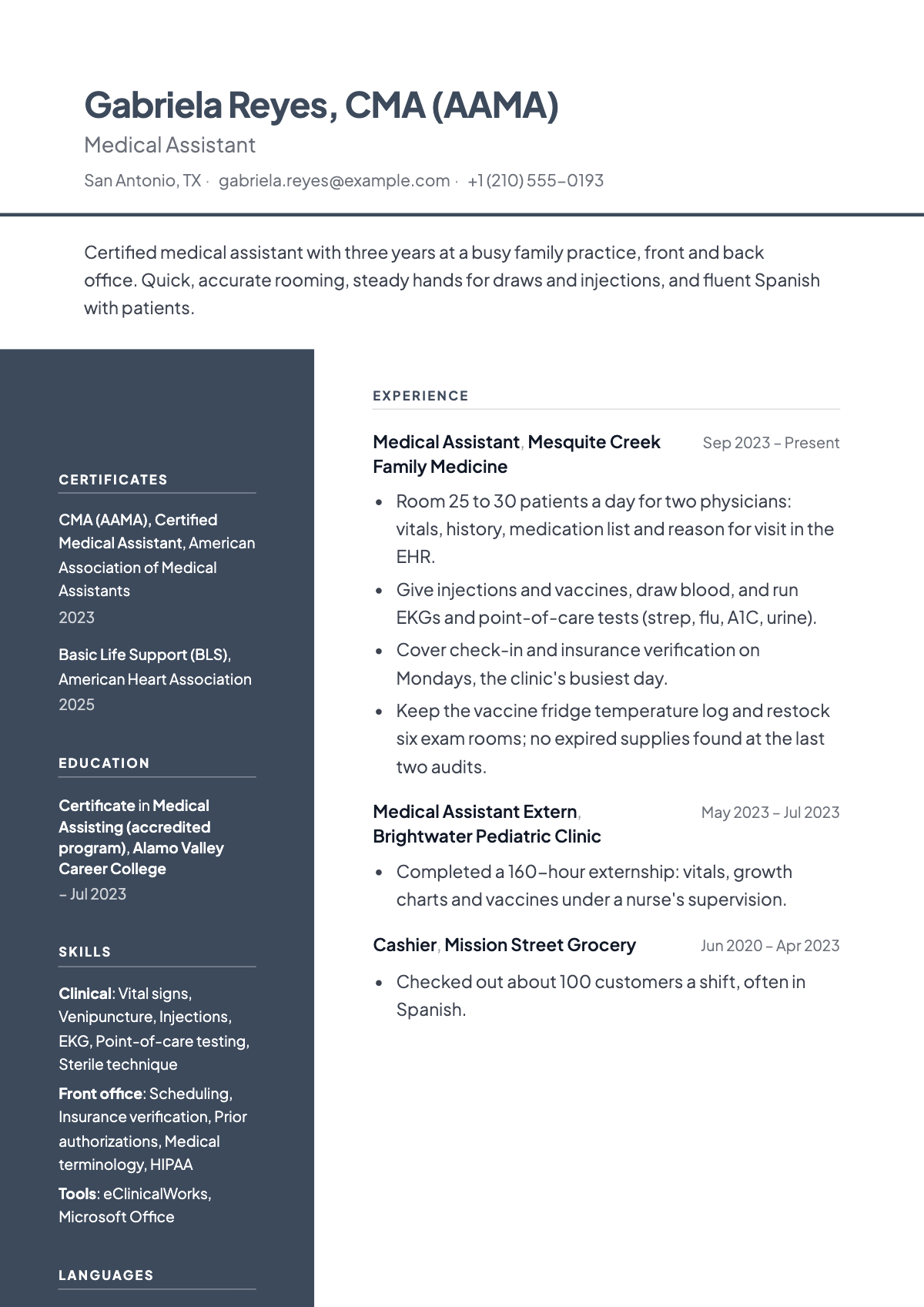
You can build your resume here with Gabriela's as a model and swap in your own clinic.
Questions
Do I need a certification to work as a medical assistant?
Most states do not require it, but some states do, and employers may prefer or require it. Medical assistants usually finish a certificate or associate program; some learn on the job. Some employers also ask for BLS.
What is the difference between a CMA and an RMA?
They come from different organizations. CMA (AAMA) is awarded by the American Association of Medical Assistants to graduates of a CAAHEP or ABHES accredited program. RMA is awarded by American Medical Technologists, with routes through school, work experience, the military or teaching.
How do I write my credential on my resume?
After your name, exactly as the certifying body writes it: "Gabriela Reyes, CMA (AAMA)" or "Jordan Lee, RMA (AMT)". Then list it again in a certifications section with the issuer and date.
How long should a medical assistant resume be?
One page. Two or three jobs with three or four lines each is plenty for an MA role.
Sources
- Medical Assistants, Occupational Outlook Handbook, Page modified August 27, 2026; read October 2, 2026
- A guide to CMA (AAMA) exam eligibility, American Association of Medical Assistants, Read October 2, 2026
- Recertify your CMA (AAMA) certification, American Association of Medical Assistants, Read October 2, 2026
- Registered Medical Assistant (RMA), American Medical Technologists, Read October 2, 2026
Start your resume
Building, editing and downloading are free. Downloading the PDF needs a free account.
Applying to a specific job? Jobician, from the same team, tailors your resume to the posting and drafts the cover letter. See Jobician