
Nursing resume examples for registered nurses and new grads
A nursing resume opens with your RN license, state and certifications, then each job names the unit, the patients and your usual ratio. Nurse managers scan for those facts before anything else. Keep it to one page as a new grad, two at most with experience, and write results you could explain at the interview.
Building, editing and downloading are free. Downloading the PDF needs a free account.
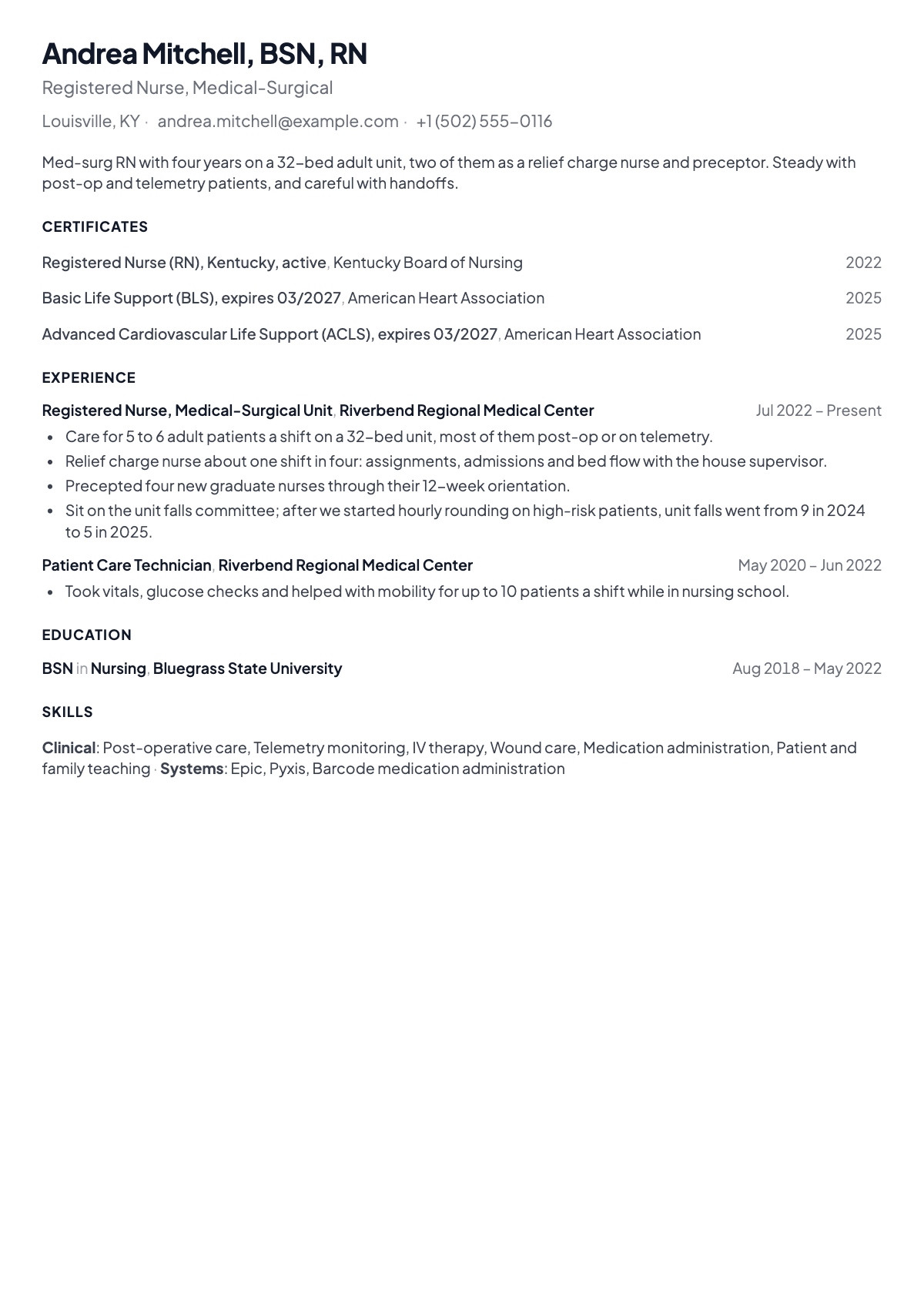
What a nurse manager looks for first
Every registered nurse holds a state license, earned by finishing a BSN, an ADN or an approved diploma program and passing the NCLEX-RN. Many nursing jobs also require CPR, BLS or ACLS certification. So the first things a manager or recruiter checks are:
- License and status: RN, the state, active or pending.
- Certifications: BLS, plus ACLS, PALS or a specialty one if the unit needs it, and whether they are current.
- Unit and patients: med-surg, ICU, ED, labor and delivery, pediatrics. Adults or children, post-op or telemetry.
- How much you carry: your usual patient ratio, and whether you charge or precept.
- The charting system: Epic, Cerner or Meditech. Knowing theirs shortens your orientation.
The rest of the page proves you are safe and steady with those patients.
The order of sections
| You are | Order |
|---|---|
| Experienced RN | Name with credentials, license and certifications, summary, experience, education, skills |
| New grad RN | Name with credentials, license (or "pending"), summary, education, clinical rotations, preceptorship or capstone, other healthcare work, skills |
Write your credentials after your name, degree first, then license: Andrea Mitchell, BSN, RN.
Nursing resume examples: bullet lines by unit
Start each job with one line of context (unit type, number of beds, patient population), then add results. Swap in your own numbers.
Where your numbers come from
| Number | Where to find it |
|---|---|
| Ratio and beds | Your usual assignment and the unit's bed count |
| Charge or precept shifts | Your schedule, or ask your manager |
| Unit quality results (falls, infections, scores) | The unit's quality board or staff meeting slides |
| Orientees | Your own count of nurses you precepted |
Use only results your unit tracked and you helped change. Patient details never go on a resume.
Registered nurse resume skills
- Clinical: assessment, medication administration, IV therapy and starts, wound care, telemetry monitoring, post-op care, blood transfusion, sepsis screening, patient and family teaching.
- Specialty, if true: ventilator care and titrating drips (ICU), triage (ED), fetal monitoring (labor and delivery), pediatric dosing.
- Systems: the EHR you used (Epic, Cerner, Meditech), barcode medication administration, automated dispensing cabinets.
- Soft skills: clear handoffs, staying calm in a rapid response, teamwork with techs and providers, compassion, attention to detail.
Match the posting's wording where it is true for you. If it says "telemetry", write telemetry, not "cardiac monitoring".
Nursing resume summary examples
Experienced RN:
New grad RN:
How to write the license and certification lines
If you hold licenses in more than one state, list each one. Expiry dates matter: a manager wants to know you can work the first week without a renewal class.
Registered nurse resume for new grads
Your clinical rotations are your experience. List each with the hospital, unit and hours, and one line on what you did. Give your preceptorship or capstone its own entry, because it is the closest thing to a real assignment. A job as a CNA, patient care tech or unit secretary belongs on the page too: it shows you know how a unit runs.
Mistakes that cost nurses interviews
- No unit or ratio. "Provided patient care" could mean anything. Say where, to whom, and how many.
- An expired BLS or a missing expiry date. Many nursing jobs require current BLS, so a recruiter looks for the date.
- Duties copied from the job description. "Administered medications" is every nurse's job. Write what you were trusted with beyond it.
- Anything that could identify a patient. Leave out names, dates of care, rare diagnoses tied to a place.
- Three pages for a staff nurse job. Cut old non-nursing jobs to one line or remove them.
- One resume for ICU and clinic jobs. Move the lines that match the unit to the top for each application.
You can build this resume here and keep the license block exactly as shown.
Questions
Should I put my RN license number on my resume?
It is optional. Your license type, state and status are enough on the resume. Employers verify the license themselves, often through Nursys, the national database run by the National Council of State Boards of Nursing, and the application form asks for the number.
How long should a nursing resume be?
One page for a new graduate. Experienced nurses can use two pages, especially with charge, precepting or specialty certifications to show. More than that is usually too much for a staff nurse role.
What if I have not passed the NCLEX yet?
Write your expected test date, for example "NCLEX-RN scheduled, November 2026", or "RN license pending" once you have applied to your state board. Update the resume the day you pass.
Do I list certifications that have expired?
No. List only current ones, with the expiry month for BLS and ACLS. If one lapses soon, renew it before you apply, because many employers require it.
Is a nursing resume different from a nursing CV?
Yes. A resume is a short summary for a job. A CV is a longer academic record (research, teaching, publications) used for faculty, research and some advanced practice roles.
Sources
- Registered Nurses, Occupational Outlook Handbook, Page modified August 27, 2026; read October 2, 2026
- NCLEX registration steps, NCSBN, Read October 2, 2026
- Nursys license verification, NCSBN, Read October 2, 2026
Start your resume
Building, editing and downloading are free. Downloading the PDF needs a free account.
Applying to a specific job? Jobician, from the same team, tailors your resume to the posting and drafts the cover letter. See Jobician